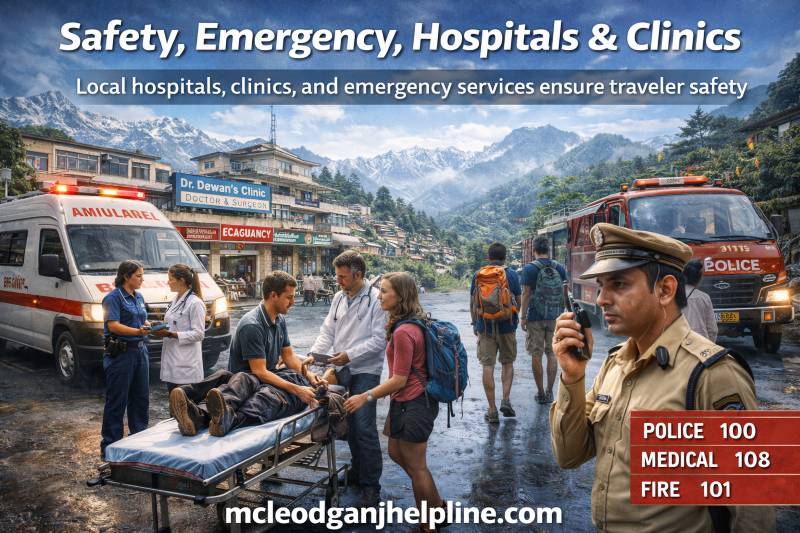
AI Overview:- McLeodganj Healthcare Overview
Healthcare in McLeodganj is built around small clinics and referral-based emergency care. Serious medical cases are typically transferred to Dharamshala hospitals. Knowing this structure helps reduce risk during emergencies.
📑 Table of Contents
- 🚑 Immediate Safety & Emergency Basics
This phase focuses on urgent medical readiness in McLeodganj, explaining what to do first during emergencies, where initial care is available, and how visitors and residents can respond calmly and effectively.
- 🏥 Healthcare System & Hospital Types
This phase explains how healthcare delivery is structured, including the role of clinics, government hospitals, and private facilities serving the McLeodganj region.
- 🔮 Future Outlook & User Needs
This phase looks ahead to 2026, explaining why healthcare awareness is increasingly important and identifying who benefits most from this guide.
- 🧭 Practical Use & Real Scenarios
This phase translates healthcare knowledge into practical steps and real-life examples that reflect actual experiences in the region.
- 🔐 Trust, Risks & Final Guidance
The final phase addresses limitations, clears misconceptions, and provides balanced guidance to help users make informed decisions.
- ❓ FAQ
- 📝 Editorial Reviews
- ⭐ User Reviews
🩺 Executive Summary & 2026 Overview
An overview of how emergency healthcare works in and around McLeodganj, with realistic expectations for 2026.
Healthcare in McLeodganj is best described as basic but functional for common needs. The town primarily relies on small clinics, local doctors, and first-response services for immediate care. For serious injuries or medical emergencies, patients are usually referred to larger hospitals in nearby Dharamshala. This referral-based system has remained consistent and is expected to continue through 2026.
Travelers and long-term visitors often assume that hill towns have full-scale hospitals, but that is rarely the case. In McLeodganj, stabilization comes first, followed by transport. Knowing this structure helps reduce panic and improves outcomes during emergencies.
By 2026, increasing tourism and seasonal crowding may place additional pressure on local clinics. However, road connectivity to Dharamshala and ambulance coordination remain the backbone of emergency response. Preparation, awareness, and realistic expectations are the most important safety tools.
McLeodganj handles first aid and stabilization locally, while advanced treatment is typically provided in Dharamshala.
People Also Ask
Is there a major hospital in McLeodganj?
No, McLeodganj mainly has clinics and small facilities. Major hospitals are located in Dharamshala.
⚡ Quick-Start Emergency Tips
Three essential actions everyone should take before or upon arriving in McLeodganj.
TL;DR Emergency Readiness
- Save local emergency and ambulance numbers on your phone
- Know the fastest route to Dharamshala hospitals
- Carry basic medical information and identification
Network connectivity can be inconsistent, so keep key numbers written down as well.
People Also Ask
Should tourists carry medical documents in McLeodganj?
Yes, carrying basic medical information and ID is strongly recommended.
📘 Detailed Healthcare Breakdown
A practical explanation of how medical care is delivered in this hill region.
Healthcare around McLeodganj operates on a tiered system. Local clinics and dispensaries manage common illnesses, minor injuries, and basic diagnostics. These facilities are usually the first point of contact.
For conditions requiring imaging, surgery, or specialist care, patients are referred to district-level hospitals in Dharamshala. This system is common across hill regions due to terrain and population density.
Understanding this structure helps patients make faster decisions and reduces delays during emergencies.
Expect referrals for anything beyond basic treatment.
Do private hospitals exist near McLeodganj?
Yes, private hospitals are mainly located in Dharamshala and nearby towns.
💰 Logistics & Cost Comparison
An overview of travel distance, time, and general cost considerations.
Hospital Access Overview
General comparison of healthcare access points
| Facility Type | Location | Typical Use |
|---|---|---|
| Local Clinic | McLeodganj | Minor illnesses and first aid |
| Government Hospital | Dharamshala | Emergency and trauma care |
| Private Hospital | Dharamshala | Specialized treatment |
Government facilities are generally more affordable than private hospitals.
How far is Dharamshala from McLeodganj?
Dharamshala is approximately 7 to 10 kilometers away by road.
📈 Why This Matters in 2026
How tourism growth and changing travel patterns affect healthcare demand.
As McLeodganj continues to attract visitors, healthcare demand is expected to rise steadily. Seasonal crowding can strain clinics and transport services.
Awareness and personal preparedness will play a larger role in ensuring timely care by 2026.
Prepared travelers reduce pressure on local systems.
👥 Who This Guide Is For
Understanding the main user groups who rely on this information.
Primary Audiences
- Short-term travelers
- Long-term residents
- Senior visitors and families
Each group faces different healthcare risks and planning needs.
❗ Common Pain Points & Solutions
Key challenges and how informed planning helps.
Distance, weather conditions, and limited local facilities are the most common challenges. Knowing referral routes and acting early helps overcome these issues.
Delaying care while hoping symptoms improve can lead to complications.
✅ Benefits for Different Users
How preparedness improves outcomes for each user type.
When people understand the system, they respond faster and communicate more clearly with healthcare providers.
Preparation reduces stress during emergencies.
🗺️ Search Intent & User Journey
How and when people seek healthcare information.
Users typically search for healthcare information either while planning a trip or during a health concern on arrival.
Clear guidance helps users make quick decisions.
🪜 Step-by-Step Emergency Handling
A simple process to follow during medical emergencies.
Emergency Steps
- Assess the situation calmly
- Contact local emergency services
- Proceed to the nearest referral hospital
Do not attempt risky self-transport if professional help is available.
📍 On-the-Ground Case Studies
Realistic scenarios based on common experiences.
In most serious cases, patients receive initial care locally and are then transferred to Dharamshala for further treatment.
Early stabilization often makes a critical difference.
⚖️ Pros, Cons & Pitfalls
An honest look at strengths and limitations.
Accessibility to basic care is good, but advanced specialization is limited locally.
Knowing both strengths and limits improves decision-making.
❌ Common Myths & Mistakes
Separating assumptions from reality.
A common myth is that all emergencies can be treated locally, which is not the case.
Assuming full hospital services locally can cause delays.
🔒 Privacy, Security & Trust Signals
Protecting personal and medical information.
Carrying identification, insurance details, and emergency contacts helps ensure safe and efficient care.
Keep copies of important documents secure.
📝 Editorial Verdict & Conclusion
Final guidance and key takeaway.
Healthcare safety in McLeodganj depends largely on awareness and preparation. Knowing where to go, what to expect, and how to act ensures better outcomes for everyone.
Informed decisions lead to safer experiences.
FAQs
Is there a hospital in McLeodganj?
There are clinics; major hospitals are in Dharamshala.
How far is Dharamshala hospital from McLeodganj?
Approximately 10–12 km by road.
Are ambulances available?
Yes, though response time depends on weather and traffic.
Is emergency care available at night?
Basic emergency support is available.
Are private hospitals better than government ones?
Both have roles depending on the situation.
Do hospitals accept insurance?
Acceptance varies by facility.
Is McLeodganj safe for elderly travelers?
Yes, with proper planning.
Are pharmacies easily available?
Yes, basic medicines are available locally.
What about serious trauma cases?
They are referred to larger hospitals.
Is altitude a health concern?
Some visitors may experience mild altitude effects.
Are doctors available daily?
Clinics operate on regular schedules.
Is emergency surgery available locally?
Usually not; referrals are made.
What languages do doctors speak?
Hindi and English are commonly spoken.
Are children’s health services available?
Basic pediatric care is available.
Can tourists access government hospitals?
Yes, government hospitals serve everyone.
Is medical evacuation possible?
Yes, in coordination with authorities.
Are COVID-like outbreaks handled locally?
Initial care is local, escalation if needed.
Do clinics handle minor injuries?
Yes, such cases are commonly treated.
Is mental health care available?
Limited services are available.
Should travelers carry medical documents?
Yes, it is strongly recommended.
🔧 Other Safety & Emergency
No other guide found